Resilient Operations Are Under Cost Pressure

Resilience is not about absorbing shocks. It’s about designing operations that don’t break around a rapidly shifting environment. COOs are being asked to increase throughput without adding headcount, reduce costs without sacrificing quality and improve reliability without major capital investment. But here’s the uncomfortable truth: Most organizations don’t have a throughput problem—they have a bottleneck problem.
A Real Example of a multi-million-dollar backlog with a technology misdiagnosis.
Recently, a global electrical manufacturer brought OpExecs to temporarily help manage a backlog that had ballooned to $2.5M. Local leadership had invested >$10M the previous year in new technology, assuming faster machines would fix the problem. But it soon became clear the issue wasn’t speed. It was flow.
What we found.
The true constraint was the final assembly—several downstream stations that set the pace for the entire value stream. But they were starved by three unreliable upstream feeders, each with its own bottleneck:
- Forming station: Tool breakage, turret loading issues, and equipment downtime
- Wiring station: No dedicated labor, causing unpredictable idle time
- Dielectric test cage: Long cycle times and too few qualified operators due to high‑voltage safety requirements
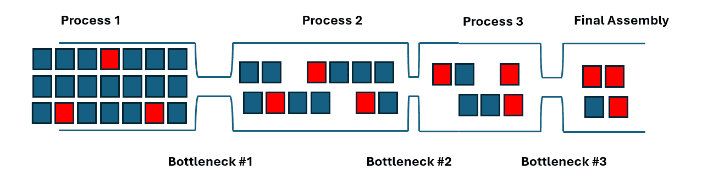
Around this constraint, four symptoms appeared:
- No flow discipline or daily management system
- Supervisors making reactive decisions
- Everything labeled “HOT,” so nothing was truly prioritized
- Defects (depicted by the red squares) only caught at final assembly
What we did.
- Focused labor on the true bottleneck stations and ran them 24/7
- Installed a poka-yoke first-article inspection gauges on critical forming equipment
- 3D-printed a visual system so material “water spiders” could track critical parts
- Re-established flow discipline and daily tiered accountability
- Implemented Root Cause Analysis for missing/defective parts (red squares)
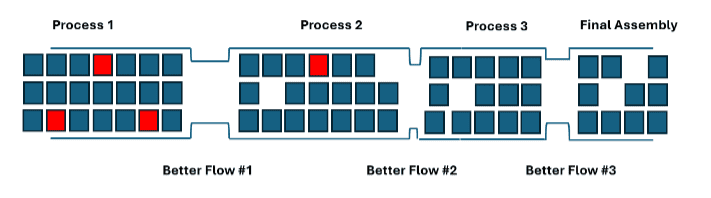
Did the $10M technology help? Yes—but only after flow was restored. Once the constraint was protected and upstream variation reduced, the new technology delivered the supporting speed and quality it was designed for. Before that, it was effectively stranded capacity.
The result was a backlog reduced by 80%. Customer confidence was restored without additional capital required. But the most important lesson for the operational leaders was this:
“If you fail to maintain flow discipline, Finance will eventually force headcount cuts and inventory reductions – and overdue orders will explode again.”
The sustainment anchor.
Of everything we implemented, the single change that would unravel the rest if it lapsed was supervisors maintaining daily accountability for protecting the bottleneck. That discipline is the backbone of resilience.
Resolve backlogs and systemize how you overcome bottlenecks for your business today. Schedule a free consult with us!
A Real Example of a bottleneck in a healthcare setting, affecting 300-400 patients a day

During that same period, we worked with a large urban pediatric ambulatory care organization operating five primary and specialty care clinics.
At one clinic, we observed a bottleneck between patient check-in and in-room vitals. Every patient was routed through a single Flow Nurse, which created backups in the waiting area and pulled this critical role away from managing exceptions and responding to variable situations. The team:
- Redesigned the flow so techs could pull patients directly from the waiting room, rather than routing every patient through the Flow Nurse.
- Implemented several iterations of PDSA (Plan, Do, Study, Act) to learn how the new process affected families’ experiences experience
- Created standard work for the Flow Nurse role to clarify how exceptions and variable situations should be handled.
- Re-established flow discipline and daily tiered accountability
- Tracked cycle time to confirm the constraint was not simply shifting later in the patient visit.
- Identified opportunities to share tasks amongst a pod of professionals assigned to work together for the day.
The team then implemented a control plan to continuously monitor cycle time and address new bottlenecks as they appeared in clinic operations. The daily huddle agenda was expanded beyond staffing discussions to include process performance, flow issues, and follow-up actions.
Workforce Capability: The Center of Industry 5.0

Industry 5.0 is not about automation replacing people. It’s about technology amplifying human capability. Over the next few years, the COO agenda is shifting from “tools and systems” to:
- Decision-making maturity
- Problem-solving capability
- Daily management discipline
- Cross-functional flow awareness Your frontline teams must be able to:
- Identify waste
- Escalate issues early
- Run micro-PDCA/PDSA cycles
- Solve problems at the source
- Sustain improvements without external consultants
This is why capability building may be the most important investment a COO can make this year. Too many organizations try to use technology to compensate for weak processes, uneven standards, and teams that have not been equipped to solve problems at the source.
The organizations that win will build people who can see flow, leaders who can coach and develop others, and management systems that provide the right information at the right time to support effective decisions. In short, they will sustain and grow capability by enabling people, exposing waste in processes, and using technology to strengthen decision-making rather than mask operational weakness.
This is the heart of Industry 5.0.
Call To Action for COOs: Make this the year where operational discipline becomes a competitive advantage, not an excuse as to why you can’t compete.
If you want to strengthen resilience, cost discipline, or workforce capability, OpExecs can help.
We specialize in senior-only, hands-on, practical Lean and CI consulting that builds capability – not dependency.