
Transferring work from one site, business, or function to another can be one of the most complex operational challenges an organization will face. With transfers, you can encounter a litany of financial, human resource, intellectual property, and operational issues. The good news is that there is a systematic approach for transferring work that can help you ensure success.
What Is a Transfer of Work?
Transfer of Work, or TOW, involves the movement of all products, people, materials, and associated activities from one site to another. These are often manufacturing operations but can also involve service processes, back-office functions, or entire business units. A TOW may be triggered by a merger or acquisition, a facility consolidation, a strategic decision to nearshore or offshore operations, or simply a need to centralize a function that has been spread across multiple locations.
Regardless of the reason, the stakes are high. When a TOW is not properly managed, it can negatively impact customer service, quality, and profitability. Orders get missed, institutional knowledge walks out the door, and the people on both sides of the transfer lose confidence in leadership’s ability to execute.
There is no such thing as a “cookie cutter” approach to transferring work. Each transaction has its own unique demands and complexities. But there is a proven framework that brings structure to the process: the toll gate methodology.
For a complete walkthrough of how this framework works in practice, watch our Transfer of Work video series, which covers the five different toll gates and how they apply to the transfer of work process.
Why a Systematic Approach Matters
Most work transfers fail not because of bad strategy but because of poor execution. The decision to consolidate, merge, or relocate is typically made at the executive level with clear financial rationale. The breakdown happens when that decision meets operational reality: the processes that need to move, the people who need to transition, the systems that need to integrate, and the customers who need to be served without interruption throughout.
A systematic approach forces the organization to confront these realities before they become emergencies. It ensures that the right questions are asked at the right time, that risks are identified and managed proactively, and that the people responsible for executing the transfer have clear roles, timelines, and decision-making authority.
A TOW is not a standard project. It involves moving live operations while maintaining service levels, often across different geographies, cultures, and regulatory environments. The toll gate methodology recognizes this complexity and provides the control points needed to manage it from strategy through decommission.
The Five Toll Gates of a Successful Transfer
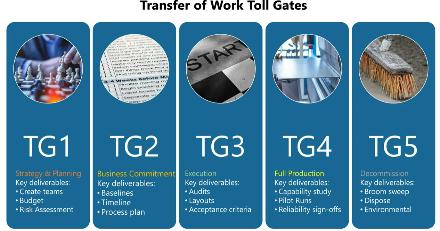
The toll gate methodology provides a structured, phase-based approach to managing a transfer of work. Each toll gate serves as a control point where the project is reviewed and validated before the team is permitted to advance to the next phase. The team cannot pass through the gate until the required deliverables are complete and approved by the appropriate stakeholders.
Toll Gate 1: Strategy and Planning
The first toll gate establishes the strategic foundation for the entire transfer. Before any work moves, leadership must define the objectives, the scope, and the expected outcomes. This is also where the transfer team is assembled, the budget is established, and the initial risk assessment is conducted.
Key deliverables:
- Create teams with clear roles and responsibilities for both the sending and receiving sites
- Establish the budget, including contingency for unforeseen risks
- Conduct an initial risk assessment to identify threats to the strategic objectives
Critical at this stage is the question of resources: have we involved enough team members at the front-line level to identify risks and ensure value extraction? The people closest to the work often see risks that leadership cannot, and their early involvement sets the tone for the entire transfer.
Toll Gate 2: Business Commitment
Once the strategic direction is set, the second toll gate secures business commitment by establishing the baselines against which the transfer will be measured. This is where the organization defines what “good” looks like at the receiving site and commits the resources needed to get there.
Key deliverables:
- Define performance baselines so the team knows the standard the receiving site must meet or exceed
- Develop a detailed timeline with milestones and decision points
- Document the process plan that maps how work will move from the sending site to the receiving site
This is also the phase where the operational Transfer of Work checklist is developed. This checklist must be customized to the specific industry, function, work locations, and environment to ensure both the catcher (receiving site) and pitcher (sending site) roles are clear and critical steps are not missed. The goal is to minimize disruption to customers as the transition occurs.
Toll Gate 3: Execution
The third toll gate governs the hands-on execution of the transfer. Processes begin to move, systems are configured at the receiving site, and the team validates that the work can be performed to the required standard in the new environment. This is where the planning from Toll Gates 1 and 2 is put to the test.
Key deliverables:
- Conduct audits to verify that the receiving site’s processes, equipment, and personnel meet the defined standards
- Finalize layouts for production floors, workstations, or service environments at the receiving site
- Establish and validate acceptance criteria that define when the transferred work is considered ready for production
Knowledge transfer is especially critical during this phase. The people who have been running the process at the sending site carry institutional knowledge that cannot be captured in a document alone. Shadowing, parallel operations, and structured handoff protocols help ensure that the receiving team has what it needs to maintain quality and service levels.
Toll Gate 4: Full Production
The fourth toll gate marks the transition from controlled execution to full production at the receiving site. The work is now running in the new location, and the focus shifts to validating that it performs reliably at scale. This is where the organization proves that the transfer has been successful before moving to close out the sending site.
Key deliverables:
- Conduct a capability study to confirm the receiving site can consistently meet quality and output requirements
- Run pilot production to test the full workflow under real-world conditions before scaling up
- Obtain reliability sign-offs from stakeholders confirming that the transferred processes meet performance standards
This is the gate where leadership must resist the temptation to declare victory too early. Pilot runs may go smoothly, but sustained production at volume often reveals issues that did not surface during limited testing. Patience and discipline at this stage protect the long-term outcome of the transfer.
Toll Gate 5: Decommission
The final toll gate addresses what happens at the sending site after the work has been fully transferred. This phase is often overlooked, but it carries its own set of operational, financial, and regulatory responsibilities. Decommissioning is not simply turning off the lights. It involves the orderly disposal of equipment, the environmental remediation of facilities, and the formal closure of the site’s operational footprint.
Key deliverables:
- Perform a “broom sweep” to verify that all products, materials, intellectual property, and documentation have been transferred or properly disposed of
- Dispose of equipment, inventory, and materials in accordance with company policy and regulatory requirements
- Address environmental obligations, including remediation, waste disposal, and any permits or compliance requirements tied to the facility
Skipping or rushing the decommission phase can leave the organization exposed to regulatory penalties, unresolved lease obligations, or environmental liabilities that surface months or years after the transfer is considered complete.
For a detailed look at how each of these toll gates works in practice, watch our Transfer of Work video series.
Essential Tools for Managing a Transfer of Work
| Tool | Purpose |
| Operational TOW Checklist | Customized to the specific industry, function, and environment. Ensures both pitcher and catcher roles are clear and critical steps are not missed. |
| Risk Assessment | A formalized process for identifying risks to strategic objectives. Each function and location should maintain its own assessment, with centralized program management reporting to the CEO. |
| FMEA | Failure Modes and Effects Analysis. Used for high-risk processes to identify steps most likely to fail during transition and design countermeasures in advance. |
| Change Management Plan | Considers the unique cultures involved and provides a transparent approach to integrating all participants so that full optimization occurs. |
Key Questions Every Leader Should Ask
Before, during, and after a transfer of work, leadership should be able to answer these questions with clarity and confidence:
- What are the strategic objectives of this transfer, merger, or acquisition?
- What are the key risks to deployment?
- Who are the key stakeholders, and are the right leaders involved to follow a disciplined approach to program management?
- Have we involved enough team members at the front-line level to identify risk and ensure value extraction?
- Who are the key employees that will need to temporarily assume multiple roles while still focusing on their regular operational duties?
- How will we measure success?
- How will this transfer afford us economies of scale to control our operating costs?
- How do we evaluate and integrate multiple systems with our existing infrastructure?
- How can we integrate our operations as quickly as possible without compromising quality or service?
- How important is culture integration now that we are combined?
- How defined and effective are our communication methods within and between organizations?
- What do our customers say about their specific priorities, and how will we enhance these post-transfer?
If your leadership team cannot answer these questions today, the toll gate framework provides the structure to work through them systematically rather than reactively.
Common Mistakes in Work Transfers
Underestimating knowledge transfer. Process documentation alone does not capture the institutional knowledge that experienced employees carry. Without structured shadowing, parallel operations, and hands-on training during Toll Gate 3, the receiving team will struggle to maintain quality and throughput.
Treating the transfer like a standard project. A TOW involves moving live operations while maintaining service levels. Standard project management tools are necessary but not sufficient. The toll gate approach adds the operational control points that a standard project plan lacks.
Neglecting change management. The people on both sides of a transfer are affected. Without a deliberate change management approach that considers the unique cultures involved, resistance builds, morale drops, and the transfer takes longer and costs more than planned.
Declaring victory at Toll Gate 4. Full production sign-off does not mean the transfer is complete. Organizations that skip or rush the decommission phase (Toll Gate 5) risk regulatory penalties, unresolved lease obligations, or environmental liabilities that surface long after the transfer is considered done.
Skipping the risk assessment. Every transfer carries risk: to customers, to employees, to quality, and to the bottom line. A formalized risk assessment, maintained by each function and managed centrally, is not optional. It is the mechanism that turns potential surprises into managed events.
Watch the Transfer of Work Video Series
Whether you are navigating a merger, consolidating facilities, or relocating a function to a new site, the toll gate framework provides the structure you need to manage the complexity without losing control of the outcome.
Our Transfer of Work video series walks you through all five toll gates, from Strategy and Planning through Decommission, and shows how they apply to real-world transfer scenarios. Each video builds on the last, giving you a practical roadmap you can apply to your own organization.
If your organization is facing a transfer of work and needs expert guidance to plan and execute it successfully, schedule a meeting with the OpExecs team to discuss how we can help. You can also explore our approach to M&A + Strategic Transfers for a deeper look at how we support organizations through complex operational transitions.